
Hansel and Gretel
A long time ago, on the edge of a vast and leafy forest, there lived a family who were going through hard times.
The house that sheltered them was full of cracks; the wind crept through holes in the walls and made the candles tremble, as if the cold itself was trying to drive them out.
The father, a woodcutter with calloused hands and a stooped back, worked from dawn till dusk, chopping wood until his muscles ached so much he could barely lift his arms.
But despite all his effort, the weight of poverty did not lift. Every evening he would return home, dragging his feet, carrying only a couple of logs under his arm.
The mother, her eyes distant and tired, would check the empty pantry again and again, as if hoping that just looking might make something to eat appear.
They had two children, Hansel and Gretel, who were as close as two peas in a pod.
One night, when the moon was shining in the sky, the parents spoke in whispers, thinking the children were asleep.
“What are we going to do?”
asked the father, his voice cracking as he looked at the tiny pantry, where only a few crumbs of bread were left.
“There’s barely enough food for tomorrow.”
The mother, her eyes glassy and her face drawn from sleepless nights, replied in a murmur, almost as if she was talking to herself:
“What’s the point of keeping them here, watching us with hunger and desperation?”
She swallowed hard and turned to the father, her expression hardened by fear.
“Tomorrow, we’ll take the children into the deepest part of the forest. We’ll give them some bread, light a fire so they won’t get cold, and then… we’ll leave.”
The father shuddered at her words and shook his head.
“I can’t believe you’re even thinking that. Leave our own children alone in the forest? They could get lost, or worse!”
The mother sighed, her shoulders sinking, as if an invisible weight was crushing her.
“I don’t want to leave them, but… what choice do we have? If we stay as we are, we’ll all starve.
This… this gives them a chance. Maybe they’ll find help… or we’ll find something to bring home. But if we all stay here, there’s nothing ahead but misery.”
The children, who weren’t sleeping but listening to every word from the corner of their little room, felt chilled with fear. Gretel, with tears in her eyes, whispered to Hansel:
“What are we going to do? They’re planning to leave us in the woods.”
Hansel, always the clever one, wiped away his sister’s tears and whispered with determination:
“Don’t worry, Gretel. I’ll find a way to get us home.”
That night, when everyone seemed to be asleep, Hansel got up silently.
Every creak of the wooden floorboards made him hold his breath, terrified that the smallest noise would wake their parents.
He opened the door carefully and slipped outside.
The full moon lit up the yard and the distant forest, and on the ground, the white pebbles shone like tiny moons fallen from the sky.
Hansel crouched down and touched them: they were cold and rough against his skin, a sensation that brought his thoughts into focus.
He filled his pockets with as many as he could.
His fingers moved quickly, almost desperately, as he kept glancing back at the house to make sure no one moved behind the dark windows.
When he was finished, he slipped back inside and closed the door with care.
Despite the fear gnawing at his chest, Hansel lay back in bed with a little smile. It was a small smile, full of hope, because he believed in his plan.
‘We won’t let the forest beat us,’
he thought, and closed his eyes.
At dawn, their mother woke the children.
“Time to get up, we’re going to the forest to gather wood,”
she said, handing each of them a small piece of bread.
“This is for lunch—don’t eat it yet, because there’s no more.”
Gretel tucked her bread into her apron, since Hansel’s pockets were full of pebbles, and together they followed their parents into the heart of the forest.
As they walked, Hansel stopped now and then to drop a white pebble along the path. The father, noticing that the boy was falling behind, asked:
“Hansel, why do you keep stopping?”
Hansel answered innocently:
“I’m looking at my little white cat, who’s waving to me from the roof.”
But the mother, overhearing, quickly cut in:
“That’s not your cat, silly, it’s just the morning sun shining on the chimney.”
But Hansel wasn’t looking at cats or the sun; he was making sure his plan would work, leaving a trail of white pebbles that gleamed in the sunlight.
After making their way home thanks to the pebbles Hansel had dropped, the children thought their troubles were over.
But food was still scarce and the future uncertain.
One night, as a gentle breeze whispered through the cracks of their humble home, the parents spoke in hushed voices again, thinking the children were asleep.
“We’ll have to do it again,”
the mother whispered, barely more than a breath.
“But this time, even deeper in the forest, so they can’t find their way back.”
The father, heavy-hearted, finally nodded.
“There’s no other choice...”
he answered sadly.
Hansel and Gretel, once again listening in the shadows, felt fear creeping over them. Gretel looked at Hansel, her eyes shining with tears in the darkness.
“They want to leave us in the woods again,”
she whispered, trembling.
“Don’t cry, Gretel. I’ll try to protect us again,”
said Hansel, trying to sound braver than he felt.
That night, Hansel tried to sneak out for more pebbles, but found the door locked and couldn’t open it. He crept back to bed, his plans in ruins.
The next morning, before the first ray of sunlight could peek over the horizon, the mother woke the children.
Her voice was firm, almost cold, as she said:
‘Come on, children, today we’re going even deeper into the woods to gather wood.’
When the mother gave them bread, Hansel held it in his hands, noticing how light it felt.
‘Not enough to eat… but maybe enough to help us find our way home,’
he thought. He decided to use the bread as a replacement for the pebbles, clinging to the only hope he had left.
As they followed their parents further and further into the forest, Hansel broke his bread into tiny crumbs.
He glanced now and then at Gretel, who walked beside him with her head bowed, and at the barely visible trail of crumbs he was leaving behind.
“Hansel, why do you keep looking back?”
asked the father, seeing Hansel lagging behind.
“I’m looking at my little dove, who’s waving to me from the rooftop,”
replied Hansel, using his wits to hide his real plan.
“Don’t be daft! That’s not your dove, it’s just the morning sun shining on the chimney,”
said the mother, impatiently.
When they reached a part of the forest that was completely unfamiliar, the father said:
“This is fine. Let’s gather wood and then we can rest.”
Together, Hansel and Gretel helped pile up wood, making a small mountain of sticks and dry leaves. The father lit a fire, and before leaving with the mother, he said:
“Stay here, children. This fire will keep you warm. We’ll be back later.”
The children sat close to the fire. Gretel took out her bit of bread and shared it with Hansel, since he’d dropped his along the way.
“All we have to do now is wait until nightfall and follow the breadcrumbs back home,”
said Hansel, trying to comfort Gretel.
But when the moon began to light up the forest, they found the crumbs had vanished. The little birds of the forest, drawn by the bread, had eaten every last piece.
“Hansel, what are we going to do now? The crumbs are gone,”
sobbed Gretel.
Hansel’s heart shrank at the fear in his sister’s voice. The birds had taken away their only hope of finding their way home.
Hansel swallowed hard, his mind searching for another way, but the weight of failure pressed down on him, making him feel small, lost in an endless forest.
“Don’t worry, we’re bound to find our way back,”
said Hansel, though in his heart he too felt afraid.
Gretel leaned on Hansel, tired, tears running down her cheeks, while he tried to stay positive.
But the darkness was thick and the cold seemed to seep into their little bodies.
Just as hope was slipping away, a gentle, almost ghostly light appeared among the trees. Gretel stopped and pointed, her eyes wide with surprise and wonder.
‘Look, Hansel… do you see that?’
Hansel squinted, and together they walked towards the light, each step careful and slow.
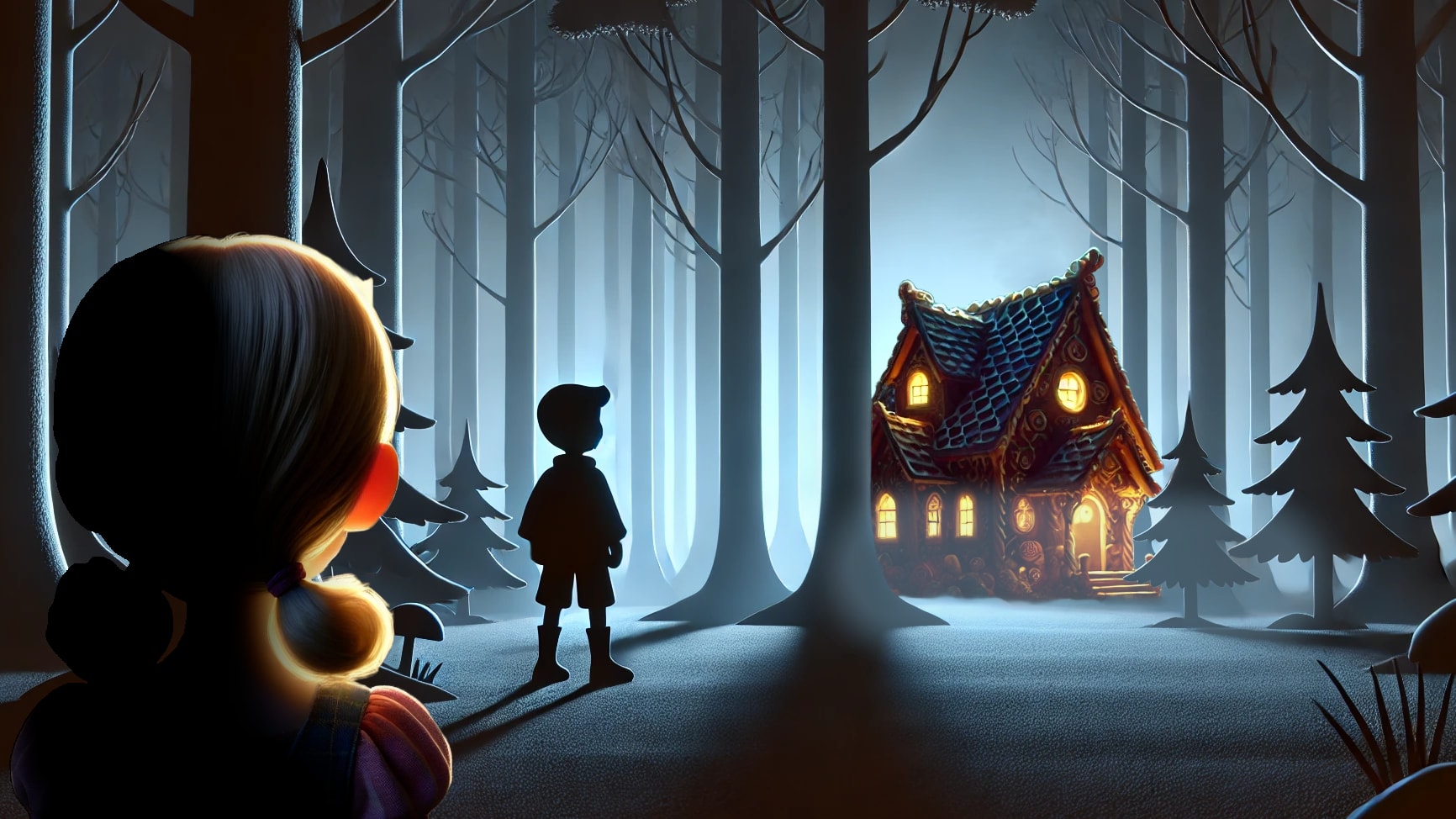
Then, among the dark trunks and flickering shadows, a little house appeared, as if out of a dream.
As they drew closer, the children were left open-mouthed.
The house was made of bread, sponge cake, and windows of clear sugar that glistened in the moonlight, as if they were enchanted glass.
A sweet aroma filled the air, wrapping around them and drawing them closer.
“We can eat this house so we don’t go hungry!”
cried Hansel in delight, forgetting his worries for a moment.
As Hansel and Gretel broke off bits of the house and popped them into their mouths, the sweet taste filled them with relief and comfort.
But then, from inside the house, a strange sound could be heard: something between a whisper and a growl, moving along the very walls.
Hansel froze for a moment, his hand suspended in the air, as the fear that had faded slowly crept back.
‘Who’s nibbling at my lovely house?’
The children looked at each other, and fear settled in their bellies like a heavy stone. They had no choice but to answer, and with trembling voices they said together:
‘It’s the wind… the north wind blowing strong.’
‘It’s the wind… the north wind blowing strong.’
There was a moment of silence.
A silence so deep that even the trees stopped their whispering.
The door of the little house flew open.
The sound echoed like thunder across the quiet clearing.
Out stepped an old woman, leaning on a twisted stick, her eyes small and shining with a strange, feverish light.
Her smile seemed warm, but something about her made the children take a step back, an uneasiness they couldn’t explain.
‘Hello, little ones. Who’s brought you here? Come inside with me, I won’t harm you.’
Hansel and Gretel exchanged a wary glance, but hunger and exhaustion were stronger than their doubts.
With hesitant steps, they followed the old woman inside the house.
Once inside, the old woman offered them a feast of sweets and little cakes, then led them to two soft beds where they could rest.
“Now sleep, children, and tomorrow will be another sweet day,”
said the old woman with a smile.
But when the door closed, Hansel felt that something wasn’t quite right.
That night, while Gretel slept, he lay awake, troubled by a feeling he couldn’t shake.
The next morning, the old woman woke Hansel and took him outside to a little pen. Gretel was woken abruptly, and the old woman said:
“Up you get, girl. Make something nice for your brother to eat. I want him nice and fat.”
“Why just Hansel? Aren’t we both going to eat?”
asked Gretel, confused and worried.
“Don’t you worry, dear. Just do as I say,”
replied the old woman, with a smile that didn’t reach her eyes.
With a heavy heart, Gretel did as she was told.
Days passed, and Gretel saw how the old woman only fed Hansel the finest food, while she was left with scraps.
One morning, the witch approached Gretel. Her shadow stretched across the floor, swallowing the girl up.
Gretel, kneeling by the stove, felt the weight of the old woman’s gaze before she heard her voice.
‘Fetch water and light the fire,’
the witch ordered, her tone full of impatience, as if something inside her was burning.
‘Today, we’re cooking something special.’
Gretel paused, the bucket trembling in her hands, her eyes fixed on the flame in the stove, as if searching for a way out.
‘What are we going to cook, ma’am?’
The witch’s eyes glinted with raw malice. She leaned towards Gretel and whispered:
‘Your brother,’
her words followed by a harsh laugh, a sound that seemed to tear the air and fill the forest clearing with its grim echo.
Gretel looked towards the pen where Hansel was locked up. Her brother stared back at her with wide, frightened eyes. Gretel swallowed hard, trying to control the terror rising inside her.
‘I have to think… I have to do something,’
she told herself, desperately searching for a way out.
While the witch prepared the oven, Gretel pretended to be confused:
“I don’t know how to do it. Could you show me how to get inside the oven?”
“What a silly girl you are! It’s easy,”
snapped the witch, stepping up to the oven to show her. At that moment, with all her strength, Gretel pushed her inside.
The witch’s screams filled the air, Gretel slammed the door shut, and the howls were trapped within.
She leaned against the door, her legs trembling so much she could hardly stand.
Gretel ran to free Hansel.
‘You did it, Gretel!’
he cried, hugging her, his eyes shining with tears. Gretel, barely holding back her own tears, nodded, and together they hurried back into the house.
There, they found chests full of treasure.
“These are worth more than any pebble!”
cried Hansel, filling his pockets.
To the children, these treasures were more than just riches: they were a promise of a life without hunger, without the fear of ever being abandoned again.
With the treasures safely gathered, the children fled from the forest.
The woods seemed darker and thicker than ever, but this time their fear was not so strong, for they carried something they didn’t have before: the certainty that, together, they could overcome anything.
Soon the forest began to look familiar.
They ran as fast as their legs would carry them and, at last, saw their house. They fell into their parents’ arms, who wept for joy at the sight of them.
“We’re here. We’re safe now.”
That day, the house was filled with laughter and tears, but above all with the promise of a new beginning.
What brought them the most happiness was not the gold coins, but the love and safety of being together once more, as a true family.
And that is all… for the moment.
Til the next tale.