Jack and the Magic Beans
Once upon a time there was a boy named Jack, who lived with his mother in a little cottage. They had almost nothing, just a cow called Daisy, whom they cared for tenderly.
Every morning she gave them milk, and later they would earn a few coins from it at the market. And so it went for a while, always the same: milk her, walk, sell, and head back home.
But one morning, Daisy did not give a single drop.
Jack’s mother sighed, looked at the empty pantry, and said:
—Daisy is old now. Today you will have to take her to market and sell her.
Jack felt terribly sad when he heard that, because he was fond of Daisy. With a heavy heart, he tied a rope around her neck and set out with her along the road.
He had not gone very far when he met an old man with a curious look about him, one of those who seem to know more than they say.
—Where are you going, lad?
—To the market. I have to sell the cow.
Jack replied.
—No need to go that far. I’ll trade you for this.
The old man opened his hand and showed him five beans.
—That is not worth a cow, and certainly not this one.
—They are magic beans.
To Jack, that changed everything. Even so, it was all a little strange. But… what the heck! The old man had a walking stick, and he spoke like someone who knew things.
He handed over Daisy, tucked away the beans, and ran home in excitement.
—Mother! Guess what they gave me for Daisy.
—Five pounds? Ten? Fifteen?
—Five magic beans!
—Jack! How are we supposed to have that for supper? There is no such thing as magic beans.
Then she snatched them and threw them out the window.
That night, they went to bed without any supper.
The next day, when he woke up, the room was darker than usual.
Jack leaned out the window and was left speechless:
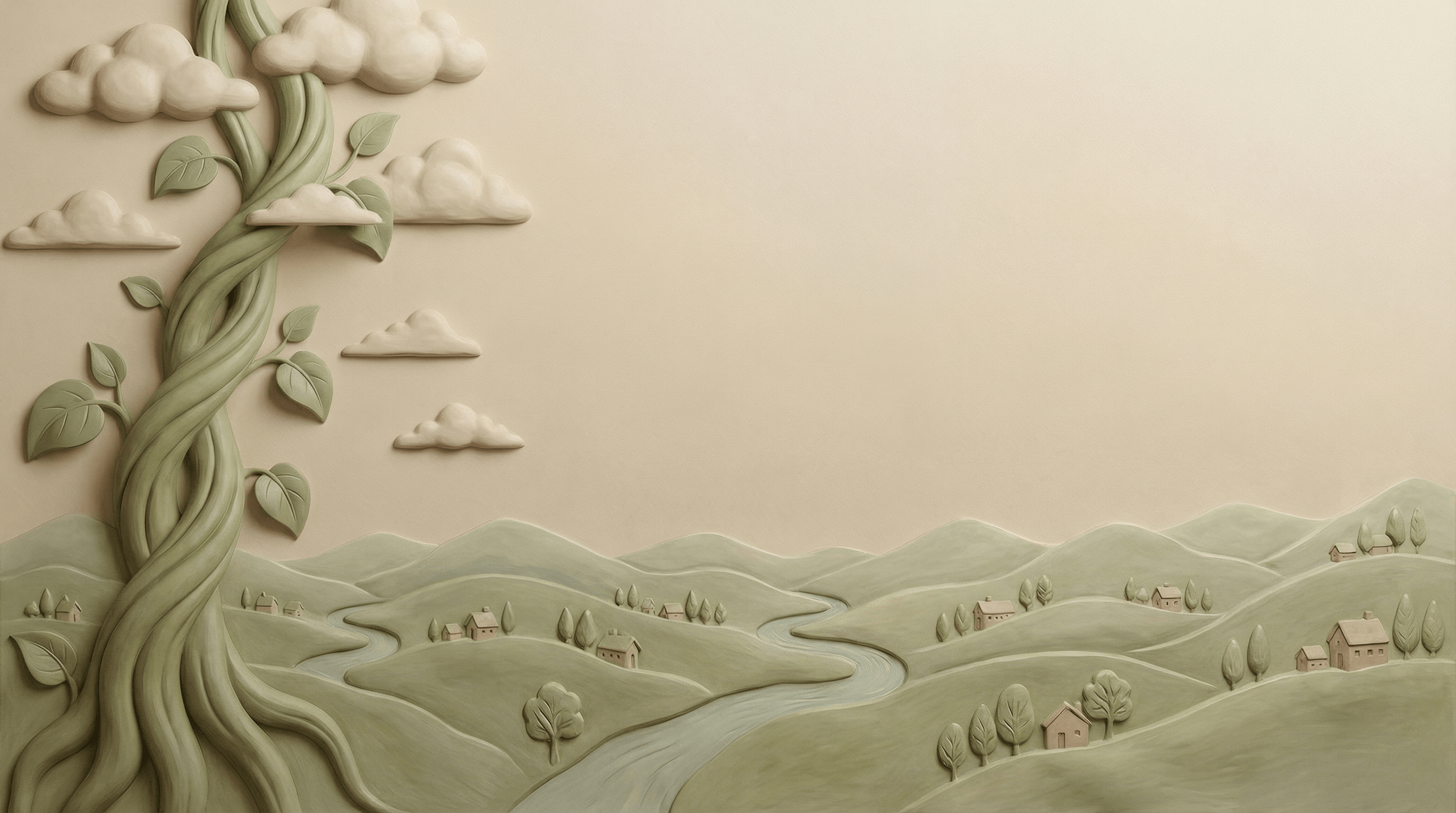
A huge plant, thick and green, rose up in front of the house and vanished into the clouds. It sprang from the ground, just where the beans had fallen.
—Oh, so magic does not exist, then?
And without thinking too much about it, he climbed out the window and began to scramble up.
He climbed for a long while, passed through the clouds, the air changed, and at last, his hands touched solid ground.
Up there, everything seemed different: the wind was cold and the silence had a strange weight to it.
In the distance he saw a house so large it looked like a castle. Since he was hungry, he went over to ask for a little food.
He knocked at the door, and it was opened by a very tall woman.
—Ma’am… could you give me something to eat?
The woman looked him up and down and, after a moment, motioned for him to come in.
—I’ll give you bread and cheese, but be quick. My husband is a giant, and there is nothing he enjoys more for breakfast than children
Jack nodded, and ate quickly.
But before he could finish, the floor began to tremble.
The woman went pale.
—It is him! Hide!
And she shoved him into the oven before he had time to protest.
The door burst open and in came the giant, enormous, with a voice that sounded as though it came from a cave. He sniffed the air, stopped, and said, slowly:
—Fee, fi, fo, fum.
“I smell the blood of an Englishman.
Be he alive, or be he dead, I'll grind his bones to make my bread.”
—It is only the wind, dear. Today the wind is carrying strange smells.
The giant sat down at the table.
—Bring me my gold.
The woman brought out a bag full of coins. The giant began to count them, one by one, and the sound of gold filled the room.
Within a few minutes, his eyes closed, his head dropped forward, and he fell asleep snoring.
Jack came out of the oven as carefully as someone stepping onto ice. He grabbed the bag, clutched it to his chest, and ran toward the plant.
He climbed down as best he could, without looking back, and when he reached the ground, he finally took a real breath.
For a while, Jack and his mother lived better, because the gold was enough for bread, for soup, and for less difficult days.
They tried to make the gold last, but soon it ran out.
Jack looked up.
The plant was still there, as though it were calling to him.
So he climbed it again.
The house was just as big, and the woman opened the door once more. This time, when she saw him, she shook her head.
—You should not be here again.
—I only need a little food, please.
She sighed and let him in, and once again gave him bread and cheese. Barely had he finished when once again the floor began to tremble.
Once again the oven. Once again the silence.
In came the giant, sniffed the air, and said:
—Fee, fi, fo, fum.
“I smell the blood of an Englishman.
Be he alive, or be he dead, I'll grind his bones to make my bread.”
—You are imagining it, dear. It must be the chimney.
—Bring me my hen.
The woman brought a black hen, with bright and watchful eyes.
—Lay, my little hen.
And the hen laid an egg of solid gold, shining like a little sun on the table.
The giant leaned back, proud, and before long he fell asleep again.
Then Jack came out of the oven, took hold of the hen firmly, and slipped away without a sound.
He climbed down the plant and showed the hen to his mother.
—Look!
"Lay, my little hen."
But the hen did nothing.
—Hmm, how strange... That is how the giant did it.
—Let me try. LAY!
At that moment, the Hen laid an egg of solid gold.
From then on, Jack and his mother lived very well.
Even so, Jack kept looking upward. There was something in that enormous house, something that pulled at him like an invisible string. And so, when some time had passed, he climbed up a third time.
This time he went in more carefully and, instead of knocking, he hid inside a dark cupboard.
Before long he heard the door thunder and felt the floor shake beneath his feet.
The giant came in, sniffed, and said, more slowly:
—Fee, fi, fo, fum.
“I smell the blood of an Englishman.
Be he alive, or be he dead, I'll grind his bones to make my bread.”
—It must be that boy. The one who stole your gold and your hen. Look in the oven.
The giant went to the oven, opened it, and saw nothing. For a moment he seemed unsure, until he struck the table again.
—Bring me my harp!
The woman brought out a golden harp, beautiful, delicate as a jewel. The giant smiled.
—Sing!
The harp began to play a soft melody, so soft it seemed the air itself was drifting to sleep with it. Little by little, the giant closed his eyes, lowered his head, and fell into a heavy sleep.
Jack came out of the cupboard, grabbed the harp, and ran. But the harp suddenly cried out:
—Master! Master!
—Shhh, be quiet!
The giant awoke as if cold water had been thrown over him. He roared and hurled himself after Jack.
Jack reached the plant, started climbing down in great haste, and heard the giant coming down behind him, with footsteps that sounded like thunder.
When Jack touched the ground, he did not stop: he ran to the shed, grabbed an axe, and came back to the base of the plant.
He struck hard.
Once.
Twice.
Three times.
The plant creaked, shuddered, and split apart.
The giant fell from above, and died.
And so from then on they lived with enough gold, and with peace at home at last.
And that is all… for the moment.
Til the next tale.